
Battery life is one of the most critical performance metrics in GPS tracker design. Whether deployed in fleet management, asset tracking, or anti-theft systems, devices are often expected to operate for months—or even years—without maintenance.
However, many GPS trackers suffer from unexpected battery drain, even when the device appears idle most of the time.
This issue is not caused by a single component, but rather by system-level design decisions—especially how motion detection and standby behavior are handled.
In this article, we break down the root causes of battery drain and provide practical engineering solutions to significantly extend battery life.
If you are comparing sensing approaches first, read our guide on accelerometer vs vibration sensor for GPS trackers, then map those choices onto your standby budget.
What Really Consumes Power in a GPS Tracker?
Before solving the problem, it is important to understand where the power actually goes.
A typical GPS tracker includes: GPS module; MCU (microcontroller); motion sensor (accelerometer or vibration sensor); communication module (GSM / LTE / LoRa).
Among these, GPS and communication modules consume the most power when active, while sensors and MCU dominate standby consumption.
The real problem is not peak power—it is continuous low-level power draw over time.
Common Causes of Fast Battery Drain in GPS Trackers
1. Continuous GPS Operation
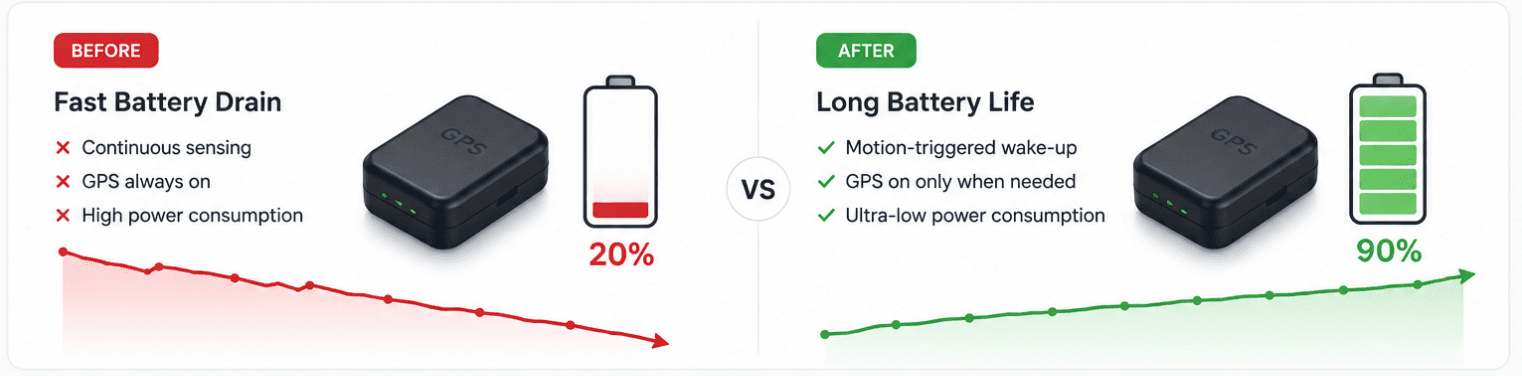
GPS modules typically consume tens of milliamps when active. Common issues include: GPS left on longer than necessary; frequent positioning updates; no intelligent wake-up logic. Even short unnecessary activations can significantly reduce battery life.
2. Always-On Accelerometer-Based Motion Detection
Traditional designs rely on MEMS accelerometers: sensor continuously powered; MCU periodically reads motion data; constant signal processing. This creates a baseline power consumption that never drops to zero.
3. MCU Cannot Enter True Deep Sleep
Because motion data must be monitored: MCU wakes up at intervals; sleep cycles are interrupted; background tasks continue running. Result: standby current remains in the µA–mA range.
4. Frequent False Wake-Ups
Accelerometer-based systems often suffer from noise: road vibration; mechanical shock; environmental disturbances. This leads to unnecessary GPS activation, increased communication cycles, and significant energy waste.
5. Polling-Based System Architecture
Most traditional designs follow a polling model: MCU continuously checks sensor data; the system remains semi-active; there is no true idle state. This is one of the biggest hidden causes of battery drain.
Engineering Solutions to Extend Battery Life
1. Adopt Event-Driven System Design
Instead of continuous monitoring: the system stays inactive during idle; it only wakes up when a real event occurs. This eliminates unnecessary processing and power usage.
2. Replace Accelerometer with Motion Wake-Up Sensor
A more efficient approach is to use a vibration-based wake-up sensor: no continuous power consumption; generates interrupt only on motion; no data processing required. This enables near-zero standby current.
See the full comparison in Accelerometer vs vibration sensor for GPS trackers.
3. Enable True Deep Sleep Mode
Design the system so that: MCU remains in deep sleep; no periodic polling; external interrupt controls wake-up. This is essential for ultra-low-power operation.
4. Optimize GPS Activation Strategy
Turn GPS on only when needed; reduce fix frequency; use intelligent tracking intervals. This reduces active power consumption significantly.
5. Minimize Communication Overhead
Batch data transmission; avoid frequent network connections; optimize protocol usage. Communication modules are major power consumers.
A Better Approach: Motion Wake-Up Architecture
Instead of continuous sensing, modern designs use a motion wake-up architecture:

Idle system behavior
Sensor remains passive (effectively no standby load into the sensing path); MCU stays in deep sleep; GPS module remains off.
When motion occurs
Sensor generates a hardware interrupt; MCU wakes up instantly; GPS module activates; data is collected and transmitted; system returns to sleep.
This creates a true event-driven system.
Our team summarizes this stack on the Motion Wake-Up solution page, with architecture diagrams for hardware teams.
Real-World Impact

In real-world applications, switching to motion wake-up design can achieve: up to 70% reduction in standby power consumption; significant extension of battery life; reduced firmware complexity; lower system cost.
Read the methodology and metrics in our GPS tracker power optimization case study.
Recommended Solution
For engineers designing low-power GPS trackers, a vibration-based sensor is a highly effective choice.

Recommended device: KD1902+
Ultra-low standby current (~50 nA context); passive operation; direct interrupt output; easy MCU integration.
Product story and limits: KD1902+ article · Module lineup: sensor modules · Broader context: low power GPS motion wake-up guide.
Conclusion
Fast battery drain in GPS trackers is not just a component issue—it is primarily a system architecture problem.
Traditional designs based on continuous sensing and polling are inherently inefficient.
By adopting a motion wake-up architecture, designers can eliminate unnecessary standby power, enable true deep sleep operation, and extend battery life dramatically.
For next-generation GPS tracking devices, event-driven design is essential.
Explore products, browse radar modules for complementary safety features, or contact us for samples and integration support.
Interactive Demo
Building a GPS tracker, asset tag, or fleet device?