
1. Background
Battery life is one of the hardest problems in GPS tracker design—especially for vehicle tracking, asset monitoring, fleet, and logistics where devices must run for months or years without frequent service. Continuous motion sensing and always-on standby often waste power and shorten usable life.
GPS tracker power consumption has become more critical as IoT deployments grow in remote locations. Traditional MEMS-based motion paths work, but they can dominate the standby budget. Teams are looking for architectures that cut idle drain without losing reliable wake-on-movement.
For the physics of passive wake-up and IoT battery life, see also: How vibration sensors extend IoT battery life.
2. The Challenge
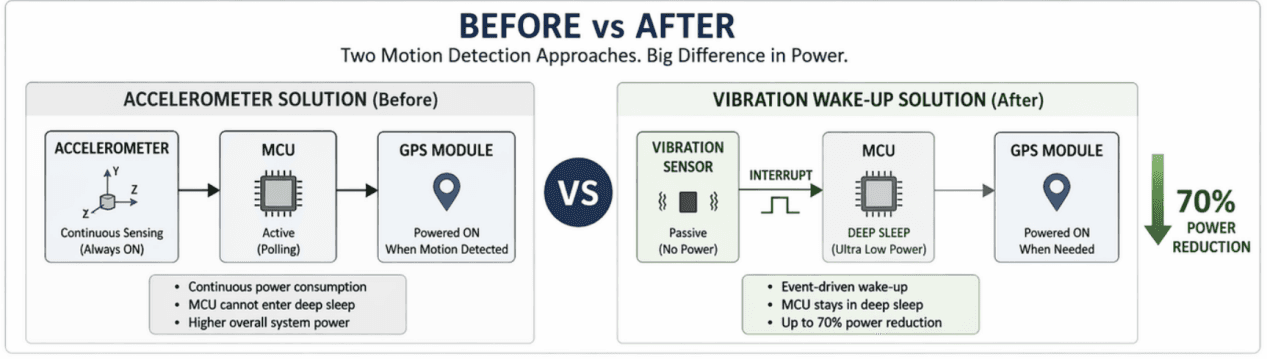
A leading GPS tracker manufacturer faced: short standby battery life, high drain from continuous motion sensing, complex firmware for sensor fusion and polling, elevated BOM from MEMS accelerometers, field complaints about longevity, and competitive pressure from longer-life products.
The goal: extend battery life substantially without losing motion-triggered wake behavior that customers rely on for asset tracking.
• Unacceptably short battery life during standby
• Excessive power from continuous motion sensing
• Complex firmware to manage sensor streams
• Higher BOM from MEMS accelerometers
• Field complaints and competitive pressure
3. Original Design
The legacy architecture relied on a MEMS accelerometer to detect motion and wake the system.
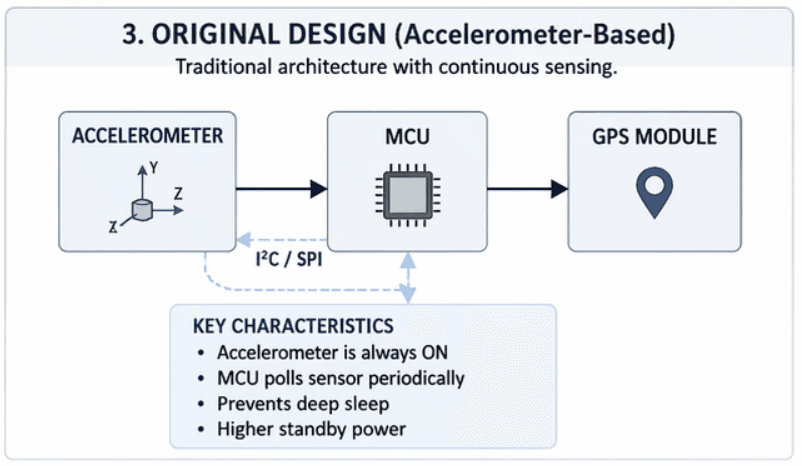
System behavior: accelerometer always powered; MCU polled motion data on a schedule; GPS turned on whenever the accelerometer path reported movement; the stack rarely reached true deep sleep.
Issues: microamp-level accelerometer baseline even when stationary; MCU could not stay in deepest sleep; false wakes from vibration and thresholds; extra I2C/SPI energy; firmware complexity for filtering.
Standby power stayed far above what the application needed because the system was always “listening” with active electronics.
For a structured comparison of sensing options, read: Accelerometer vs vibration sensor for GPS trackers.
4. Optimized Solution: Motion Wake-Up Architecture
The team replaced accelerometer-centric motion detection with a vibration-based motion wake-up sensor as the primary hardware trigger.
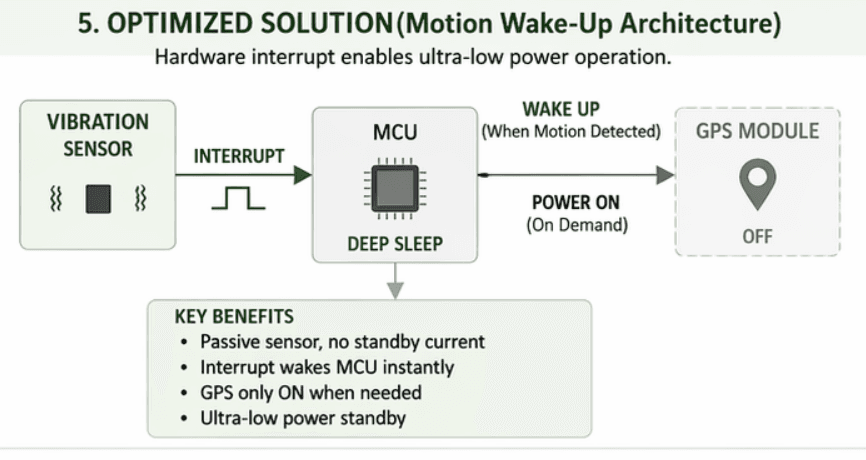
New design: vibration sensor on MCU GPIO interrupt; MCU in ultra-low-power deep sleep whenever idle; GPS fully off in standby; non-essential peripherals gated off; event-driven flow instead of polling.
On movement: sensor pulse → MCU interrupt wake → GPS powered for fix and upload → return to deep sleep. Power is spent when tracking is actually needed.
This removes continuous sensing from the standby budget and attacks GPS tracker power consumption at the architecture level.
For step-by-step motion wake-up concepts, see: Low power GPS tracker motion wake-up guide.
5. System Architecture (After)
6. Results
After shipping the motion wake-up architecture, the customer reported strong improvements across metrics (representative deployment; your results depend on firmware, battery, and RF profile).
• Standby power reduced by up to ~70%
• Longer field life between service intervals
• MCU achieved true deep sleep with microamp-level system budget in idle
• Simpler firmware and fewer active components
• Lower BOM without premium MEMS for wake-only use
• Higher reliability and improved customer satisfaction
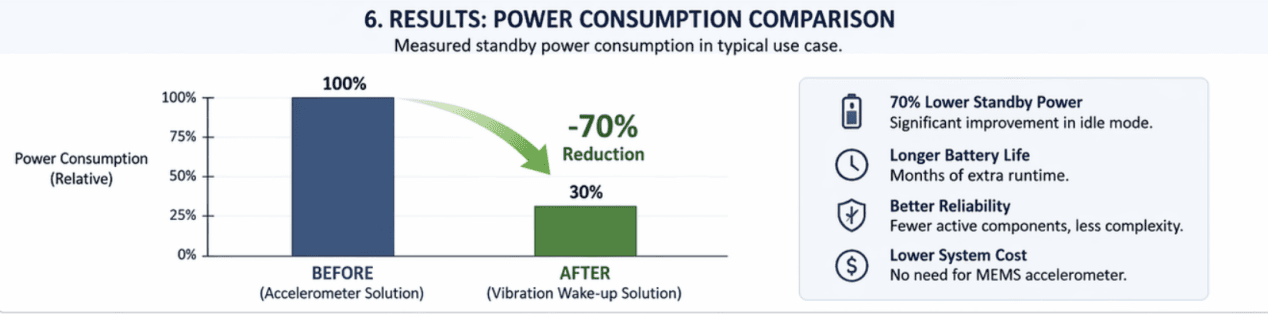
Power is now consumed mainly when movement confirms a need to locate—opening use cases that were marginal under the old standby profile.
7. Why It Works
Most GPS trackers only need motion to trigger activation—not full motion analytics. Replacing continuous sensing with a hardware trigger:
• Eliminates baseline drain during idle
• Simplifies hardware and software
• Improves reliability with fewer failure modes
• Matches the real product requirement: wake, fix, sleep
Optimization means matching the sensor class to the job—wake triggers do not need the same subsystem as activity classification.
8. Recommended Device
A practical part for this architecture is the KD1902+ omnidirectional vibration sensor: ~50 nA context for the passive path, pulse-friendly GPIO wake, compact SMD, and 360° sensitivity.
Datasheets and land patterns: KD1902+ on Sensor Modules · Product story: KD1902+ article.
9. Conclusion
Reducing GPS tracker power consumption is essential for competitiveness. This case shows that swapping accelerometer polling for a motion wake-up sensor can extend battery life, simplify design, and cut cost—while keeping the motion-to-GPS workflow customers expect.
A hardware-based wake path is a practical upgrade for next-generation low power GPS trackers.
For evaluation units and integration help, contact Kingdta.
Interactive Demo
Download the Product PDF
Get the corresponding specification sheet for this article.
Build the same motion wake-up path with KD1902+ on your next tracker.